
How Secured School Doors Saved Lives

Published by the Security Industry Association (SIA)
May 20, 2026
Groundbreaking New Research on Active Shooter Events in Schools
The Advanced Law Enforcement Rapid Response Training (ALERRT) Center at Texas State University has published new research in partnership with the Security Industry Association (SIA) that examines school safety in the United States and how schools can prevent, mitigate and reduce the impact of active shooter events.
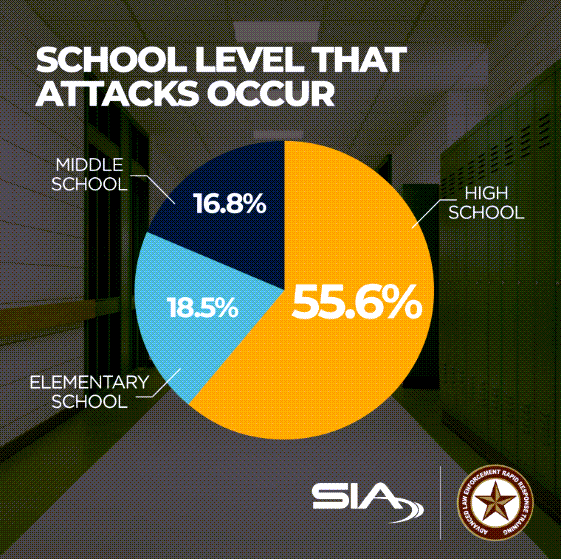
This first-of-its-kind study, The Role of Locked Doors and Access Control in School-Based Active Shooter Events, was drawn from empirical analysis of 54 school-based active shooter incidents occurring between 2000 and 2025, which resulted in 324 total victims. The report examined a wide array of factors—including who the attackers were, how they moved through schools, what types of weapons were used, when attacks were carried out and where doors were locked and unlocked—and conducted deep analysis of the 2022 mass shooting at Robb Elementary School in Uvalde, Texas, and the 2025 shooting at Evergreen High School in Evergreen, Colorado.
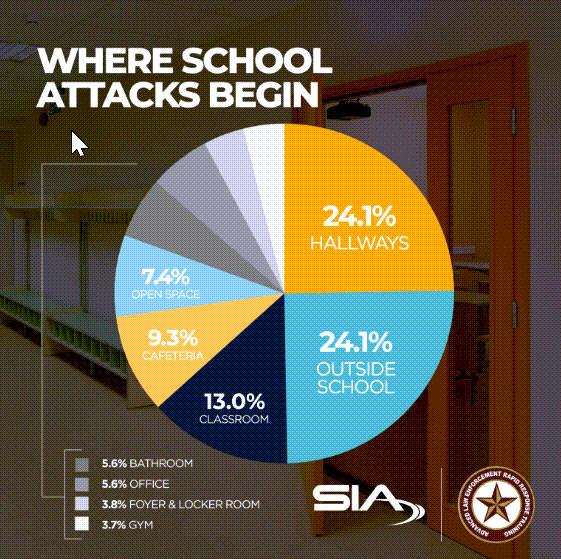
Where School Attacks Begin
- The profiles of the attackers varied greatly depending on the type of school. In high school and middle school shooting incidents, most attacks were carried out by insiders (88.9 of shooters in middle schools and 83.3% of shooters in high schools were current students). In elementary school incidents, however, none of the perpetrators were current students—all were outsiders.
- Nearly 50% of attacks were initiated in hallways (24.1%) and outside areas (24.1%).
- In active shooter incidents in schools, casualty likelihood was three times higher when doors were unsecured, compared to secured doors.
- No functioning locked door in the data set was successfully breached through defeating the locking mechanism.
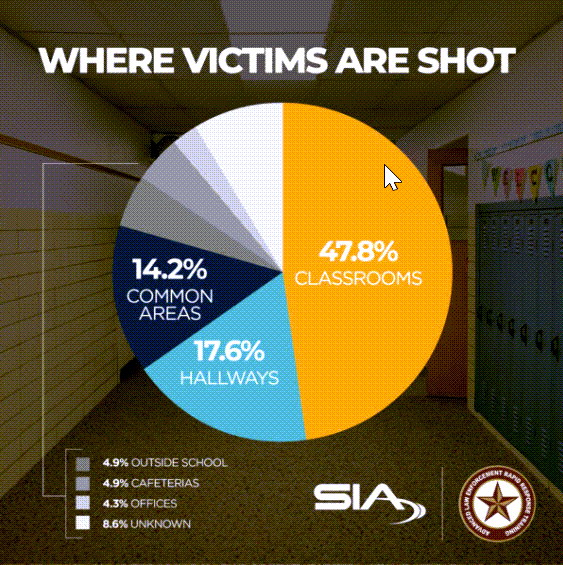
The Texas State research emphasizes that, often, school security failures are caused not by sophisticated breaches, but rather by preventable gaps in daily procedures and maintenance. The report identifies propped doors and inconsistent security practices as recurring vulnerabilities across active shooter incidents on school campuses.
“The central finding of this study is that secured doors are associated with substantially lower likelihood of casualties,” the report states. “Taken together, the evidence converges on a consistent conclusion: when doors are secured, the probability of harm to occupants behind closed door is substantially reduced. This recommendation is not novel, but the data presented in this report provide empirical grounding for a directive that has often relied primarily on expert consensus and anecdotal evidence.”
The study also highlighted the importance of delay when every second matters during such incidents. Even when attackers eventually breached barriers of entry, secured classroom doors frequently slowed movement long enough to allow lockdowns to begin, notifications to spread and law enforcement to intervene.
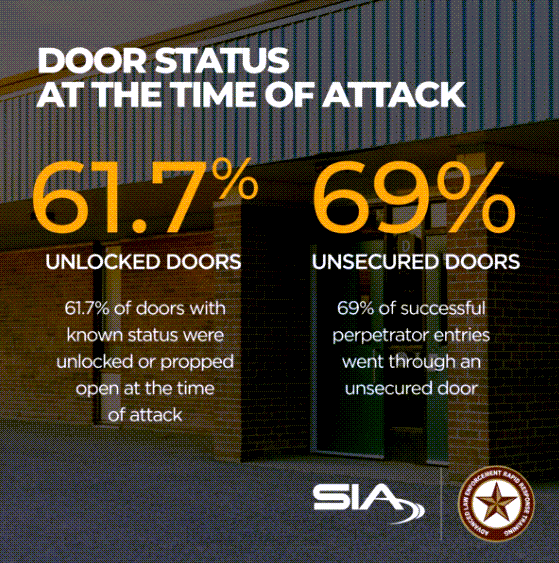
Door Status At The Time Of Attack
“The most common way an attacker entered a space was not by defeating a lock—it was by walking through a door that should have been locked but wasn’t,” said Hunter Martaindale, Ph.D., director of research at the ALERRT Center and lead researcher on the report.
“Nearly two-thirds of the doors in our dataset were unlocked or propped open at the moment of attack. The hardware only protects students, teachers and staff when it is consistently used. The available data give empirical weight to a recommendation the field has long made on principle: lock the door.”
Policy Recommendations for School Safety
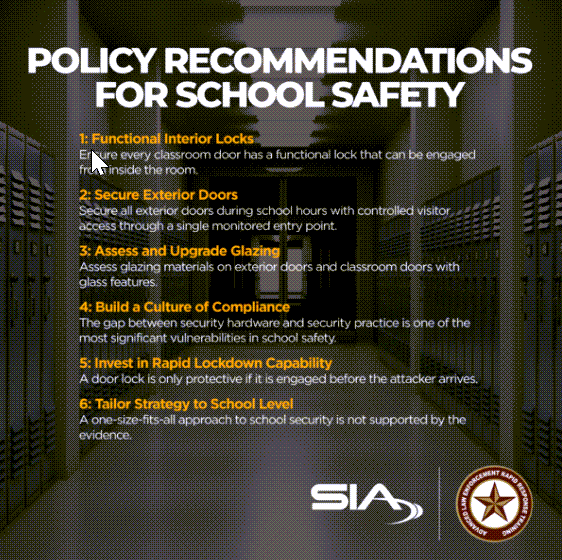
The report shared eight evidence-based policy recommendations for school administrators, security professionals and policymakers. Focus areas include:
- The foundational importance of every classroom door having a functional lock that can be engaged from inside the room
- The vulnerability of common areas such as hallways, cafeterias, gyms and courtyards
- The role of maintenance and repairs as essential security functions
- The measurable impact of school security culture and procedural compliance on outcomes
- The importance of protecting glass features in and around doors
- Strong concerns regarding aftermarket additions like magnets and door barricade devices, which the report found add unnecessary complexity and serious hazards
This independent report was supported by a grant from the SIA Endowment Program. SIA believes the findings will help inform school administrators, educators, security professionals, law enforcement entities and policymakers nationwide as they evaluate school safety best practices and structure guidance and assistance programs for schools.
Additional SDI Resources
Bullet Resistant Steel Doors
Find more information on bullet-resistant assemblies and relevant test standards.
Reducing The Risk of Forced Entry
Explore how steel doors & frames play a vital role in securing a building’s perimeter.
Blast Resistant Steel Doors
Discover how blast-resistant assemblies protect people and property.
Forced Entry Steel Doors
Learn how they keep unwanted persons out and buildings secure.