
The Lock Held. The Glass Didn’t.
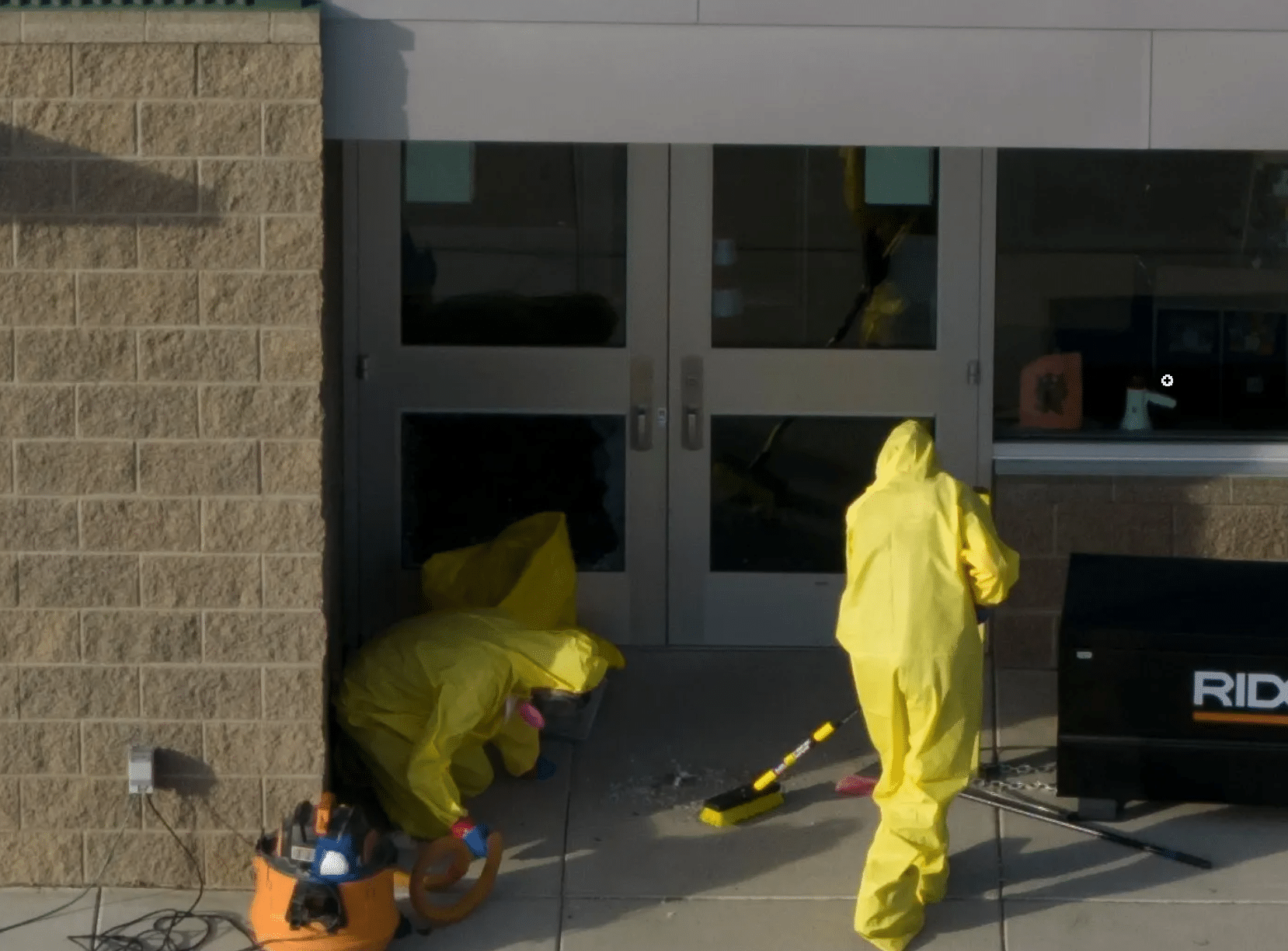
Cleanup at the exterior doors of Silver Rail Elementary School, Bend, Oregan. The lower glass pane on the left door is shattered. Image via KLCC.
Published In Tactical Science by Pete Blair
Professor of Criminal Justice and Criminology and the Executive Director of the Advanced Law Enforcement Rapid Response Training (ALERRT) Center at Texas State University
October 26, 2026
What Silver Rail Elementary tells us about school door security, and why it was predictable
Key Points
- Early reports said the Silver Rail shooter shot his way through locked doors. That is not quite what happened. He fired into the glass panes of a locked set of exterior double doors and went through the opening. The lock held. The glass did not.
- We have seen this before, every time. Across 54 K-12 active shooter events from 2000 to 2025, every attacker who forced his way past a locked door did it through glass. Not one defeated the lock itself.
- Better hardware will not fix a glass problem. If a school’s entry is mostly standard glass, the lock on it matters much less than we tend to assume.
On Thursday, October 15, a 16-year-old former student attacked Silver Rail Elementary School in Bend, Oregon with a pump-action shotgun (KPTV; NBC News). The first 911 call came in at 12:59 p.m. and officers were on scene by 1:02 (SecurityInfoWatch). In that short amount of time, three children, ages 5, 8, and 11, and a 25-year-old teacher were killed, and a 7-year-old and a 54-year-old teacher were wounded (NBC News; KPTV). Multiple citizens stepped up that day. A man approached the attacker in the parking lot before being shot at. A teacher threw her phone at the attacker and tackled him, and a father of two Silver Rail students followed him into the building and shot him before law enforcement arrived (KPTV).
The first version of the story widely publicized was that he “bypassed building security by shooting through locked doors” (SecurityInfoWatch). Plenty of people read that as proof that locks don’t work or that he breached the exterior by shooting out the locks.
The details that came out over the following days tell a different story. Police say he fired multiple rounds into the glass panes of an outside set of double doors and forced his way in through them (KPTV; NBC News). The doors were locked. The superintendent said the district had replaced every door lock in its schools with locks that don’t require teachers to leave the classroom, and that Silver Rail had run a lockdown drill about two weeks earlier (NBC News). The school went into lockdown at 1:01 (SecurityInfoWatch). By most accounts, Silver Rail had done what the guidance asks.
He didn’t beat the hardware. He went around it.
Earlier this year our team at the ALERRT Center finished a study on locked doors and access control in K-12 active shooter events (Click Here). Silver Rail tracks what we found almost exactly.
1. When attackers forced a locked door, they went through the glass every time
Attackers tried to force their way through a locked or barricaded door nine times and got through six times. All six went through glass. They shot out a glass panel in the door, a glass panel beside it, or a sidelight, and stepped or reached through the opening. Not one of them got past the lock itself.
The three failed attempts point the same way. In each, the attacker shot at the door or the lock itself, and the door held. Solid doors with working locks were never breached.
The 2023 attack at The Covenant School in Nashville, Tennessee, shows both halves in one building. The attacker got in by shooting through the glass entry doors, then went upstairs, fired at secured classroom doors, and couldn’t get into any of those rooms.
What this means for your school. When someone with a gun meets a locked door, the weak point hasn’t been the lock. It’s the glass in or beside the door. So the question to ask isn’t only about hardware. If someone shoots out the adjoining glass, can they get in?
2. Elementary schools are the most exposed, and Silver Rail fits the profile
Who attacks a school shapes which doors matter. In high schools, 25 of 30 attackers (83%) were current students, and in middle schools it was 8 of 9. Those attackers are usually inside before anything starts, so the front door never comes into it.
Elementary schools look nothing like that. None of the 10 elementary school attackers in our data were current students. Every one had to get in from outside, which makes the exterior door the main place an attacker can be stopped or slowed. Exterior doors were 37.5% of door interactions at elementary schools and 11.6% at high schools.
Those perimeter access points also have a lot of glass. Six of the seven aluminum-frame glass doors in the dataset were entry doors, and four of the six successful breaches came through that kind of door.
Silver Rail is an elementary school, the attacker came from outside, the entrance was a locked set of glass double doors, and he got in by shooting out the glass (KPTV). It is the pattern we observed in our data, nearly point for point.
What this means for your school. At elementary schools, the exterior perimeter is where physical security money does the most. A locked entrance made mostly of standard glass amounts to a lock with a window next to it.
3. Hardware and glass have to be part of the same plan
The wrong lesson from Silver Rail would be that locks don’t matter. They do. Among doors with known outcomes in our data, someone was shot behind 3 of 18 secured doors (16.7%) and behind 10 of 20 unsecured doors (50%). That gap ran the same direction in every way we cut the data. The numbers are small and the records are observational, so treat it as a consistent association rather than a precise effect size. And the most common way into a space wasn’t beating anything at all. Twenty of the 29 doors attackers got through were unlocked or propped open.
Locks matter, and actually using them matters most. But a school can get the hardware and the compliance right and still leave an opening if the doors those locks secure are mostly standard tempered glass. Tempered glass is safety glass. It’s made to break into small pieces so nobody gets cut, not to keep anyone out, and every case above shows how fast gunfire gets through it.
That’s why our report treats glazing as its own recommendation, separate from locks. Schools should assess the glass on exterior doors and on classroom doors with glass features, and where feasible replace or supplement tempered glass with security glazing or security film that meets relevant standards. Start with exterior entry points at elementary schools, since that’s where the outside threat and the glass both sit. Then move to classroom doors with glass big enough to climb through once it’s broken. A narrow vision light an attacker can reach through to the lever is a smaller problem than a half-glass door or a full sidelight someone can walk through.
Security glazing won’t make a door impenetrable, and that isn’t the point. The point is time. In December 2018, a 14-year-old’s mother called 911 to warn that he was on his way to Dennis Intermediate School in Richmond, Indiana, with guns. Officers headed to the school, and they were arriving as he reached a locked entrance. He fired three rounds from a handgun into the glass door, knocked out the glass, and went inside. Officers followed him in and exchanged gunfire with him after he ran through the hallway full of locked classrooms, and he took his own life in a stairwell minutes later. No students or officers were hurt. Three rounds were all it took to get through that door. Officers happened to be right behind him that morning, which most schools can’t count on. A door that holds for even a minute gives responders that minute.
We can’t know how the timeline at Silver Rail would have changed with security glazing at the entrance, and the investigation is still open. What we can say is that it failed at the same point we keep documenting across 25 years of these events.
What this means for your school. When the security budget comes together, count the glass as part of the door, not as a separate line that gets cut first. Walk your entrances and classroom wings, list every pane in or next to a locked door, and decide which ones need to hold.
A closing note
This post is condensed to focus on glass in schools. The full report goes into what these data can and cannot tell us, including how much door information is missing from the public record, the averted-attack cases, the Uvalde and Evergreen case studies, and all eight recommendations. If you make decisions about school facilities, start there. You can read the full report here.
Our thoughts are with Bend, and most of all with the families of the three children and the teacher who were killed. The man who confronted the attacker in the parking lot, the teacher who fought back, and the father who ran toward the gunfire did everything anyone could ask. The building should give people like them more time.
Additional SDI Resources
How Secured School Doors Saved Lives
Read groundbreaking new research on school active shooter events.
Bullet Resistant Steel Doors
Find more information on bullet-resistant assemblies and relevant test standards.
How Door Assemblies Keep Schools Safe
Explore how steel doors & frames play a vital role in school security.
Forced Entry Steel Doors
Learn how they keep unwanted persons out and buildings secure.